
Broker vs Exchange in the EUA Market: What Actually Differs

Paul Akass
article · 19 November 2026
Buyers of EU Allowances often hear “broker” and “exchange” used as if they were rivals. In practice they play different roles, and many working programmes use both.
Broker vs Exchange in the EUA Market: What Actually Differs
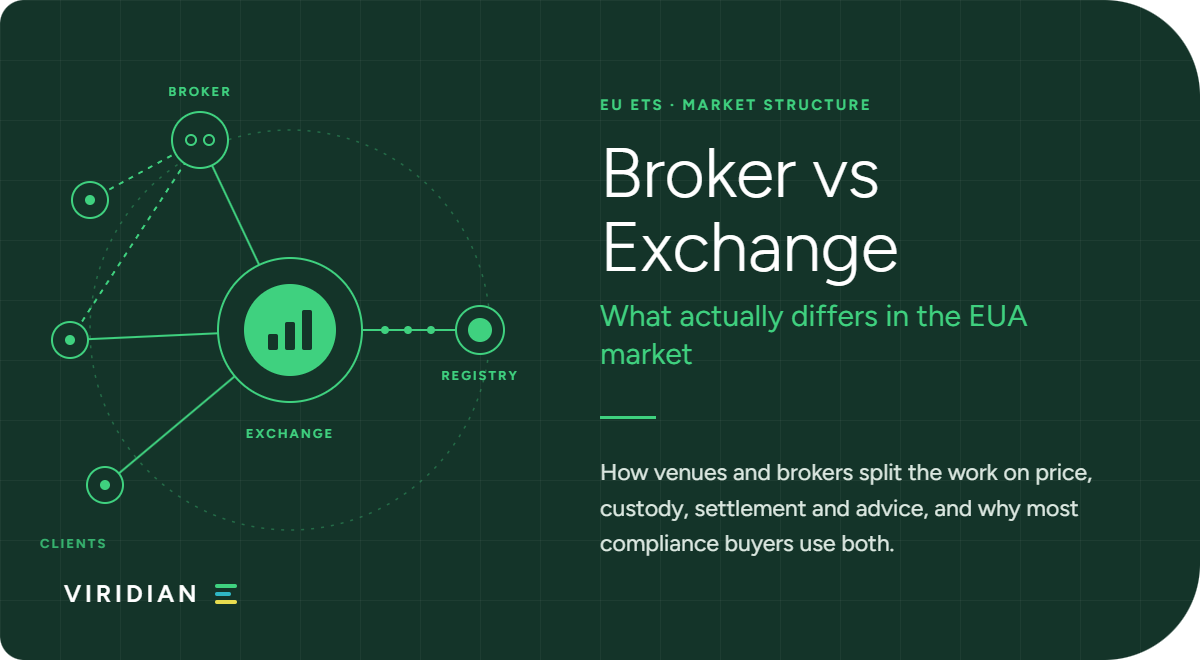
Buyers of EU Allowances often hear “broker” and “exchange” used as if they were rivals. In practice they play different roles, and many working programmes use both. This article separates the functions clearly and explains how Viridian Exchange positions itself: as an exchange offering direct access through a client portal, while brokers remain important partners for relationships, introductions and client coverage.
What an exchange does
An exchange organises a market venue. It defines tradable products, shows prices, hosts execution workflows and sets operational rules for how trades are confirmed and settled under its model. Clients (or their introducing brokers) access that venue—often through a portal—to instruct business against published or live-style indications.
For EUAs, an exchange offering focused on spot helps compliance buyers move allowances toward Union Registry delivery. When the same venue also lists or facilitates Guarantees of Origin, buyers can manage carbon compliance instruments and renewable electricity attributes in one place. Exchange design choices around account segregation and settlement structures aim to clarify custody and reduce unnecessary counterparty chains.
An exchange does not replace the client’s ETS compliance duties. Verified emissions, free allocation, surrender and registry administration remain with the operator or account holder.
What a broker does
A broker manages relationships and execution on behalf of clients. Typical work includes gathering interest, advising on timing and size, introducing clients to venues or counterparties, and coordinating documentation. Brokers earn their place when the client wants market coverage without staffing a full trading desk, or when a trade needs negotiation beyond a standard portal ticket.
Brokers do not usually run the central price screen or the custody model of an exchange. They navigate those systems—or bilateral markets—for the client. Confusing the two roles leads to poor expectations: asking a broker to be a venue, or asking an exchange to replace every advisory conversation.
Where the roles meet
In carbon and environmental markets, the boundary is porous in a useful way:
Brokers introduce industrial clients to exchange portal access and continue to cover them.
Exchanges provide the price visibility, product set and settlement design.
Clients retain registry accounts, mandates and surrender responsibility.
Energy firms may trade on the exchange directly while still using brokers for other products or regions.
The practical question for a compliance buyer is not “broker or exchange?” but “which combination gives us clear prices, reliable delivery and advice when we need it?”
Differences that show up in operations
Price discovery. Exchanges emphasise visible, live-style or session prices. Broker markets emphasise indications gathered across contacts. Many buyers watch both.
Counterparty and custody. Exchange models with account segregation and structured settlement (including RAV-style arrangements where offered) aim to shorten counterparty chains and clarify who holds what. Pure bilateral brokered trades leave more of that design to each credit relationship.
Speed of residual fills. Portal access can make small or frequent EUA Spot top-ups easier once onboarding is done. Brokered negotiation can still be preferable for large or unusual packages.
Advice. Brokers often lead on relationship advice. Exchange desks still support clients on product mechanics, GO versus EUA distinctions and settlement questions—especially for industrials new to regular trading.
Scope. Confirm whether EUA Spot, futures (if required) and GOs are in scope for the relationship you choose. Split coverage across unrelated parties increases reconciliation work.
Positioning Viridian Exchange accurately
Viridian Exchange (www.viridianexchange.com), part of AFS Energy / Viridian, operates as an exchange offering for EUA Spot and Guarantees of Origin. Clients get direct access via the AFS Client Portal at https://portal.afsenergy.nl/. The homepage shows live-style prices for EUA Spot and for GOs (Hydro, Solar, Wind and Any Tech).
The model is built around direct portal access, account segregation and an IRAV structure oriented toward faster settlement and fewer counterparty hops. Specialist desk support is available for industrial and energy clients. Brokers remain part of the ecosystem: they can work with Viridian when covering or introducing clients, rather than being cast as obsolete.
What Viridian is not claiming here is a substitute for the client’s own registry work, or a detailed public fee or lot-size comparison against every listed futures venue. The job is direct market access for EUAs and GOs, with custody and settlement designed for clarity.